
Car Scams UK: How to Spot Them Before You Pay
Common car scams include fake listings, deposits for cars you haven’t seen, cloned plates, clocked mileage and hidden finance. Nearly all of them fail against the same habits: see the car at the V5C address, check the paperwork yourself, and pay nothing until you do. 1
You’ve found a car, the price is a little too good, and the seller is friendly, fast and very keen. That mix is what most car scams are built on: a good price, a nice person and a deadline.
In this guide, you’ll learn each scam’s tell, the six rules that beat most of them, how to pay safely, and what to do if you’ve been caught.
Table of Contents
Key Takeaways
- Never pay anything, including a “holding” deposit, before you’ve seen the car.
- A clean report isn’t proof. Match the car to the record and the V5C.
- Walk away from pressure, third-party payments and “it’s with a courier”.
- Pay in a way you can trace, and keep every message.
- If you’ve been scammed, tell your bank first, then report it.
Car scams at a glance
| Scam | How it works | The tell | First check | Read more |
|---|---|---|---|---|
| Fake listing | A cheap car with stolen photos and no viewing | Photos on other ads, price far below market | Reverse image search; view at the V5C address | Who owns it |
| Deposit scam | Pay to “hold” it, then fees for delivery, “insurance”, a “release” | Deposit before viewing, gift card, crypto or link | Pay nothing unseen | Car Deposit scams |
| Fake escrow or shipping | The seller’s own “secure” payment or courier site | A link the seller sends | Find any service yourself | |
| Cloned plates | A stolen car wearing a real plate | VIN or details don’t match | The VIN test, a stolen check | Stolen check |
| Clocked mileage | Odometer wound back | MOT mileage jumps or drops | MOT history against the dash | Service history |
| Hidden finance | The seller still owes the lender | “Selling for a friend”, avoids a history check | Paid history check, V5C and ID | Who owns it |
| Hidden write-off | Crash history disguised | Clean V5C but repair signs, first registered abroad | Paid history check, inspection | Cat N guide |
| Fake private seller | A trader posing as a private seller | Same number on several ads | Ask “Is this your own car?” | Who owns it |
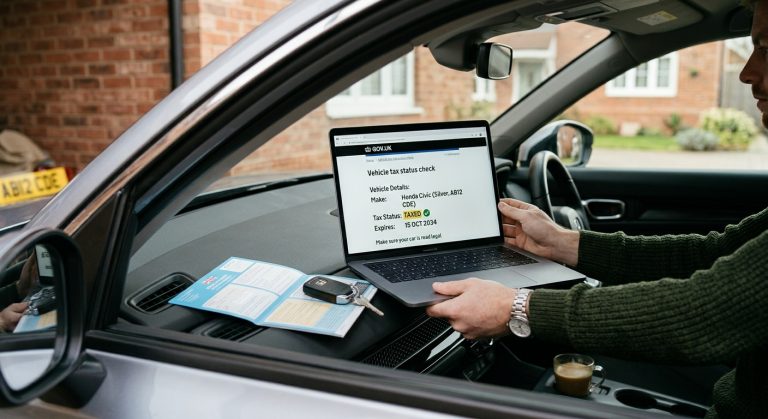
| “It’s taxed” | The seller says their tax carries over | Tax doesn’t transfer | Tax it before driving | Taxed check |
| Ghost broker | Fake insurance for new drivers | Too-cheap quote from social media | Check the broker is FCA-registered | British Insurance Brokers’ Association |
| Fake DVLA messages | Texts and emails about refunds | DVLA never asks for bank details | Use only GOV.UK | Taxed check |
Before you view
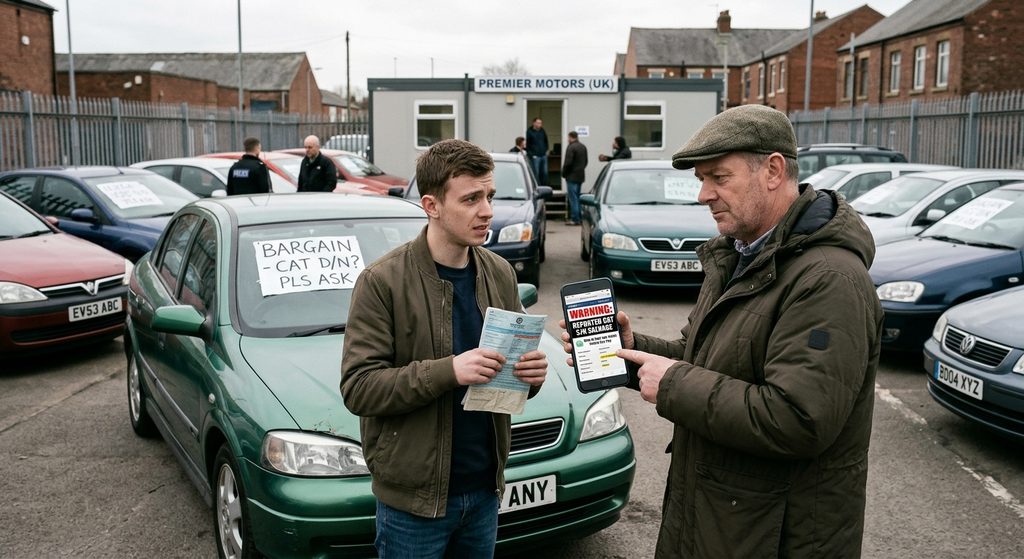
Fake listings. A real ad has several photos from different angles and a seller who’ll meet at their home. Stolen photos can be caught with a reverse image search. Excuses like “I’m away with the military”, “it’s in storage” or “I’ll ship it” are almost always the scam itself.
Deposit scams. The seller says several people are interested and asks for a deposit by transfer, link or gift card. Then come more fees, for delivery, “insurance” or a “release”, or silence. A deposit can be reasonable, but only after you’ve seen the car at a dealer’s real premises, with a written receipt showing the VIN, the amount and the refund terms, ideally paid by credit card. Never pay a deposit to a private seller you haven’t met.
Fake escrow and shipping. Be wary if the seller insists on a particular “secure” payment or shipping site and sends you the link. Find any such service yourself, or don’t use it.
At the viewing
Cloned plates. Check the VIN in more than one place (windscreen, driver’s door frame, engine bay), against the V5C. Fresh welds, mismatched rivets or scratched stamping are warning signs. Our stolen car guide has the full test.2
Clocking. Large mileage drops in the MOT history, long gaps, or repeated failures for structural corrosion, airbags or suspension are bad signs. Look at the V5C too: a duplicate (“I lost the old one”) or a car first registered abroad deserves questions.
Hidden finance and write-offs. A paid history check shows both. Until finance is paid off, the lender may still have a claim on the car. A write-off can be hidden by moving a car between countries.
Fake private sellers. Dishonest traders pose as private sellers to dodge the responsibilities of trading. [H4] Ask “Is this your own car?”, and check the name on the V5C matches the seller’s ID.
Insurance and messages after the sale
Ghost brokers sell fake insurance, often to new and young drivers, then cancel the policy and keep any refund. Be wary of cheap quotes from social media. Fake DVLA messages claim refunds or overdue tax. DVLA says it never asks for bank details, refunds tax automatically, and tells you to use only GOV.UK. Don’t post your V5C or licence online, because thieves can use the details to clone a car.
Six rules that beat most scams
- Stop and check before you pay. Pressure is the scam.3
- See the car at the V5C address, with the seller’s ID matching.
- Pay nothing before viewing.
- Run your own history check and match the VIN to the car and V5C.
- Pay traceably, never by gift card, crypto or a link from the seller.
- Walk away if the story changes.
How to pay safely
Paying by credit card may give extra protection on purchases from a trader. [H5] Bank transfers to UK accounts also carry protection if you’re a fraud victim, up to £85,000 for payments made since 7 October 2024, but only if you report within 13 months, a small excess may apply, and it doesn’t cover a dispute with a genuine seller. Paying Cash gives you nothing to fall back on.
Dealer or private sale: what protection do you have?
Buying from a trader generally gives you stronger legal protection than a private sale. Check the current rules on Citizens Advice or GOV.UK before you rely on them, and get everything in writing.
If you’ve been scammed
- Contact your bank or card provider straight away. Speed matters.
- Report it to Report Fraud, which replaced Action Fraud. If you paid by bank transfer, ask your bank about reimbursement.
- Keep every message, advert and receipt.
- Report scam texts and emails to the National Cyber Security Centre.
- Get advice from Citizens Advice.

If you’re selling
Scammers target sellers too. Groups pose as buyers, and one distracts you while another tampers with the engine to claim a fault and push the price down. Others send fake bank transfer confirmations, overpay and ask for a refund, or hand over counterfeit cheques, so wait until funds have cleared before releasing the car. Our selling guide will cover these in full.
Red flags: walk away if…
- you’re asked to pay before you’ve seen the car
- the seller won’t meet at their home
- the VIN, V5C or ID doesn’t match
- there’s a third-party payment, link, gift card or crypto
- the story changes, or the pressure rises
- it’s “with a courier”, “in storage” or “abroad”
FAQ
- GOV.UK: https://www.gov.uk/government/news/dvlas-top-tips-for-avoiding-scams ↩︎
- Start Rescue: https://www.startrescue.co.uk/breakdown-cover/motoring-advice/motoring-costs/how-to-spot-a-clocked-car-or-scam-advert ↩︎
- Warwickshire county council : https://www.warwickshire.gov.uk/news/article/7950/selling-your-car-privately-then-watch-out- ↩︎

3 Comments